
Three reasons why measuring Carbon Dioxide (CO2) is important
by Todd DeMonte
Owner and General Manager
May 2025
Reason 1) Cognition Improvement
When CO2 levels increase over the outdoor level of ~ 420 parts per million (ppm), noticeable negative human performance effects occur. From the widest lens, the Occupational Safety and Health Administration (OSHA) standard is CO2 levels should be below 5,000 ppm over an 8-hour-time-weighted average (TWA).
Back in the 1960s and 1970s, the US Navy did its own research and claimed that 11,300 ppm of CO2 was acceptable on submarines.
However, more recent studies have shown complex problem solving and executive functioning get negatively impacted by as little as 640 ppm of CO2 and the negative effects (response times increase and throughput times decrease) as the CO2 levels increase.
From 420 ppm to 900 ppm, the decrease in complex cognitive functioning is a linear relationship – meaning more CO2, even at these low levels, impairs cognitive performance.

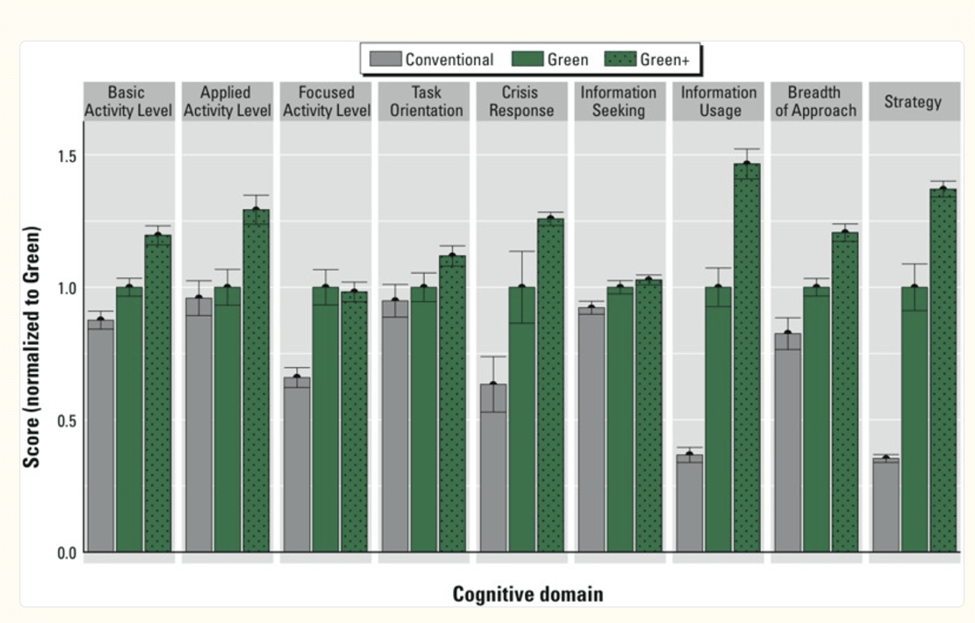
This next example highlights improved cognitive performance by comparing problem-solving abilities across three different test conditions:
- standard ASHRAE ventilation rates (gray bar),
- standard ASHRAE ventilation rates combined with green cleaning methods (green bar), and
- enhanced ventilation rates aimed at maintaining indoor CO₂ levels around 550 ppm, also paired with green cleaning methods (green-dotted bar).
The results allow us to compare cognitive function under each scenario. Green cleaning methods—which use low-VOC (Volatile Organic Compound) materials and cleaners—led to better cognitive scores than standard ventilation alone. When increased ventilation was added to the green cleaning approach, cognitive performance improved even further. These findings suggest that reducing VOC exposure and indoor CO₂ levels both contribute significantly to enhanced cognitive function.
Reason 2) Cost
So ideally, every indoor living space should have near outdoor levels of CO2 (or about 420 ppm). This is easy to do in San Diego, where the weather is almost perfect all year round – just open a window.
But in the Gulf South, with its oppressively humid summers, and the Midwest and Northeastern States, with their cold winters, bringing in air from outside (to dilute the CO2 concentrations inside) takes energy – a lot of it – to condition that outside air to a comfortable 70°F and 50% relative humidity (RH).
Controlling the amount of outdoor ventilation air that is brought inside using indoor CO2 levels is the optimal way to ensure proper ventilation levels. Many commercial buildings use this strategy. Most residential buildings – if they have ventilation capabilities – use an ASHRAE-recommended calculation based upon the number of occupants and bedrooms.
One can quickly imagine how using a static ventilation formula for a huge mansion with 2 retired people living in it would be vastly over-ventilated, leading to excess energy consumption required to condition the outside air.
Using indoor CO2 concentrations is a more direct and improved strategy for controlling ventilation air rates of outdoor air – minimizing cost (by limiting over-ventilation) and maximizing cognitive performance (by ensuring adequate ventilation).
Reason 3) Health
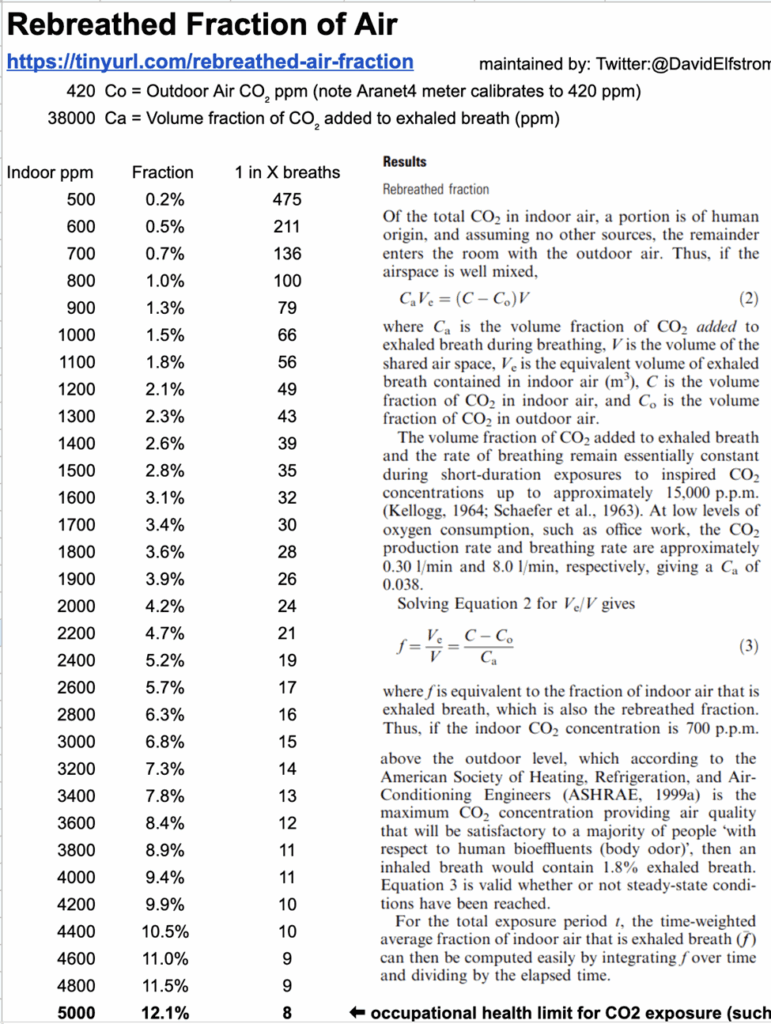
It has been a few years since the COVID pandemic ended. We learned some valuable lessons regarding airborne infections and CO2 levels. CO2 levels can be used to directly calculate how much air a person indoors is breathing that has been exhaled by another person indoors. Depending on the infectiousness of the disease-causing agent, single digit percentages of rebreathed air (from an infected person) can put one at risk for catching the infection.
David Elfstrom, an engineer from Toronto, posted a spreadsheet calculating the percentage of air that one is breathing in that has already been exhaled. The left column is the CO2 concentration in ppm. The center column is the fraction of air being inhaled that has been exhaled. The column on the right shows how many breaths it would take to breathe in the full exhalation of another person (which is usually around 40,000 ppm of CO2).
Summary
Measuring indoor CO2 levels is essential for optimizing cognitive performance and health to ensure enough outside ventilation air is provided but not too much where the extra costs to condition the air are wasted due to minimal benefits. Measuring CO2 provides direct feedback on the occupancy levels compared to the ventilation rate indoors.